Sesshin Guide Hokuozan
Here you can find the Sesshin guide book for the sesshins which take place in Hokuozan Sogenji in Germany.
Sogenji Helpbook
Rules and Explanations
September, 2025

The following rules, reminders and information are not meant to be an exhaustive list. It is up to all of us to act in a way that supports the practice of the entire sangha.
RULES, REMINDERS, INFORMATION
GENERAL:
- Always be on time for choka, zazen, meals, samu and other sangha activities.
- Be extremely careful of all fire.
- Walk quietly inside, and outside of all buildings.
- Be respectful of the quiet time: 1 hour following lunch, and also from after kaichin until wake-up bell.
- Always tell the Roshi, Chi-san or the Fuzui when leaving and returning to the temple. If you can't find any of these people, tell the daily Tenzo. This is a requirement.
- Do what the group is doing. Do not follow your personal likes and dislikes.
- Do what you are told to do by your senpai (senior).
- Begin outside cleaning from the main gate area and continue towards the Hondo, Kyozo, genkan and around the lake, if time permits. Bring twigs, branches, pine cones, acorns and other garbage collected during outside leaning to the mountain (there are several designated areas for emptying the bags). Leaves can always go to the leaves compost box. Make sure to pick all weeds when you clean the grounds.
- When moving to the zendo walk in zendo order. When moving to the Hondo or Tenzo, walk in the order that you will sit.
- Be careful when running to Sanzen, do not bump into or push other people.
- Don't wear jewelry or watches.
- If you have long hair please pull it back.
- Take good care of all Sogenji tools.
- Don't leave bicycles in any other place than where they belong.
- Don't breathe noisily during any formal practice.
- Don't spend time in other people's rooms.
- Don't wear tight or see-through clothes.
- Don't use fragrant deodorants, perfume, etc.
- Open the doors and windows completely, do not leave them half-open.
- Limit verbal communication to a minimum.
- Don't have more than one pair of shoes out at a time. Put all extra shoes in cubby boxes to make room for everyone else's shoes.
- The use of cell phones and ear buds are prohibited in public spaces. Limit their use to your private room or when using the internet in the women's zendo.
- Freedays. There are two types of freedays. The first is when we sleep in (Newasure). The second is when we start as usual then the day becomes free after outside cleaning.
-
- Newasure Freeday: Wake up at 5:50am. Start inside cleaning at 6:00 am until 6:30, or earlier if it is light. At 6:30 am, start outside cleaning. Breakfast will be after the finish call at about 7:30 am
- No Newasure Freeday: The day starts with Choka, sanzen and breakfast at normal times. After breakfast, outside cleaning for one hour then free.
- On either type of Freeday there is a mandatory dinner that begins after the evening bell. After dinner you are not allowed to leave the temple.
ZENDO:
- Be seated on your cushion at least 10 minutes before the scheduled zazen time. Bow to koban if you are late (unless you sit on the gaitan).
- If you miss a zazen period/s bow to the jisharyo (unless you sit on the gaitan).
- After sanzen, re-enter the zendo through the gaitan entrance. WIth your hands in gassho, no need to bow. Before entering the zendo, check to see if the keisaku is moving. Enter only when the keisaku has stopped moving.
- Walk and breathe quietly.
- Don't move, make noise or blow your nose after the clappers and bells announcing a zazen period and during the han.
- You can drink water or go to the bathroom during kinhin. Do it in the beginning and re-join the kinhin line as soon as possible. Kinhin is walking zen. It's the first step to bringing your zazen from the cushion into any other daily activities. Inform the jisharyo if you cannot do kinhin because of injury and then stand in front of your seat during kinhin.
- After sanzen return to the zendo quickly. It is permitted to use the restroom after sanzen. Women please use the toilet in the womens’ zendo. Men are asked to use the toilet in the Joju.(near the kitchen)
- After zazen stand in front of your cushion and let your seniors leave the zendo ahead of you.
HONDO:
- Do not leave the Hondo during teisho. If you have to leave in an emergency, wait until the teisho is finished, and then rejoin the group. It is not allowed to come back inside the Hondo after leaving in an emergency.
- Do not leave or move during the eko (dedication part that is chanted, after each sutra by Roshi or densu).
- Always hold your sutra book with both hands in front of your face. When your sutra book is not in use it should be on the tatami in front of your cushion.
- During sutra reading you are required to read the text during the whole period. Do not set the text down in front of you.
- Do not leave the Hondo during sutra reading for any reason.
KITCHEN:
- Only have one pair of shoes out, put any extra shoes in the shoe box.
- During the formal meals open your jihatsu set and place your bowls close to each other in one line at the edge of the table.
- Use your Jihatsu quietly. Picking up one bowl at a time.
- Eat quietly: do not slurp the soup, do not pierce the pickles with your chopsticks. Stack your bowls quietly, and do not strike the sides of your bowls with your chopsticks.
- Put 3-7 rice kernels on the offering tray at the beginning of the meal.
- Offer approximately one-fourth or less of the wash water at the end of the meal.
- Lift up the bowl you are eating from, and do not hold one bowl and eat from another.
KOHOJO (SANZEN WAITING ROOM)
- Once you have sat down do not get up and leave the room until the bell for sanzen rings. If you leave the Kohojo while sanzen is ongoing, reenter the room when the bell rings again for sanzen.
- Breathe quietly.
- Sit in seiza (on your knees) before going to the bell, and at the bell.
- Never come in and out the door dividing the Kohojo and the hallway next to the tearoom.
- Stand up if you cannot stay awake so as not to disturb your neighbors.
- You can go to the bathroom when waiting for sanzen, obey the rules of coming in and out of the room. Women are asked to use the bathrooms in the women's zendo, not the Guest House. The men are asked to use the bathrooms in JoJu.
OFURO (BATH):
- Men go first on even numbered days (2, 4, 6...) for 1 hour after lunch (2 pm – 3 pm). After that women from 3 pm – 4 pm. From 4 pm the bath is available for anyone. Please make sure to change the sign Men/Women when you go in.
- In winter we do not use the bath before lunch, only in case of very dirty samu like emptying the toilets or cleaning the ditches.
- Prostrate in front of the altar before and after using the ofuro.
- No talking in ofuro.
GUEST HOUSE AND HIGASHI ZENDO (WOMEN'S ZENDO):
- Be respectful of the quiet time (no talking, no noisy walking, no opening the door and closets, no laundry, etc.).
- The living room in the Guest House is available for those living in the Guest House after quiet time in the afternoon. Consult with the Guest House keeper if there are any questions
- Turn off the path light to Guest House when not in use.
- The women's zendo library can be used by both women and men in the afternoon and on free days. There is a wi-fi connection available until kaichin. Do not leave your personal things in the library and make sure to leave the library as you found it when you leave. The library is available until kaichin on a free days.
SEASONAL:
Winter (in the Zendo)
- Do not cover your hands. Do not wear socks, turtle-necks, gloves, scarves or hats unless you have special permission.
Summer (in the Zendo)
- No personal cooling devices allowed. Always be dressed in a samue top and Hakama with undershirt, or samue pinned shut at neck.
General
- Always wear a samue top unless told by a senior.
- Be mindful of electricity and water use. Do not leave the lights heaters and fans on when you are not in the room.
ITATEN/KAICHIN:
- Stand in order – when the sangha is below 20 members everyone stands on one level with 5 people in the front line and 5 in the back line. If there are more members then the first line becomes 6 people with 1 standing on the step, and the back line also has 6 people. The rest stand on the wooden boards on the lowest level. Jisharyo takes care of making sure that the right order is being kept.
Additional information
Keeping these rules helps us to deepen our practice and stay attentive, clear and compassionate. By following these rules we can also express our gratitude for the Roshi. Please be mindful of your behavior, help if there are events or other occasions where you can give a hand. Do not complain. Do not cling to your idea of free time. Free time at Sogenji is when there is no work to be done. These activities are supportive for yours and other people's practice. Please do not answer rudely when corrected.
Below the rules for Sogenji Monastery Okayama Japan
they are being read before each Osesshin
except for Rohatsu Osesshin
DONAI KISSOKU
These rules are being read by the Roshi in Japanese and in English by the head monk while the sangha sit in seiza with the head bowed down onto the tatami.
Doing Sanzen is of the utmost importance in following the way. At any time Sanzen may be requested. Always inform the jikijitsu and or jisha or your coming and going.
Enter the Zendo with Gassho, when leaving the hands should be in shashu. When moving in the Zendo observe the set rules. Do not pass back and forth in front of the altar of Monju-Bosatsu and do not walk near the tan in a way that will disturb people’s meditation.
There should be no coming and going during a period of zazen except for the times of sanzen. Going to the toilet is only to be done in the intervals between zazen. Refrain from unnecessary coming and going in and out, absolutely no speaking unless necessary.
There will be no absence from Kinhin, dragging of Zori or detaining of the walking. If Kinhin is impossible due to injury or illness, report it to the jikijitsu and stand in front of your tan during Kinhin.
The keisaku is to be used without fail, when someone is sleeping, but also if they are not sitting correctly even if they are awake. When receiving the keisaku, gassho and do teito. To raise even one egoistic thought from the person with the keisaku or to have thoughts of anger from the person receiving the keisaku is forbidden.
The two daily sareis may not be refused. Food remaining from the sareis must never be thrown away.
To make your tanbuton, tatami or desk untidy is forbidden. Nor may writing materials be kept out. Never crumple up your zazen clothes on your tanbuton and leaving through the back door in an improperly dressed condition is forbidden.
Even at times of unsupervised sitting it is forbidden to purposely sit sleepily of to sit leaning against the wall.
Even if your back and shoulders become tired from sitting it is forbidden to use the keisaku personally.
Going into town or unnecessarily spending time in the administrative quarters is forbidden. If there is some unavoidable business, report first to the jikijistu or jisha. Going into town is only permitted on free days.
During morning sutras the keisaku may be used one hit on the right shoulder to those who are continually sleeping.
After Kaichin yaza should be begin quickly with no unnecessary turning on of lights or wandering around visiting. This is not a time for anything but yaza. Do not read the sutras or do prostrations out of unison. And there is to be no whispering at these times
No travelling to far places is permitted during the time of training except to a parent or parent priests funeral.
When a new arrival enters the Zendo he will do his prostrations before Monju Bosatsu, then go and do gassho and bows to the head of the tan and the head monk. After that the new arrival goes to the jisha`s place and waits, following the jisha’s announcement of the enw arrival, he goes to the place assigned him.
During takuhatsu, don’t let your hands dangle or warm them inside your koromo. Also forbidden is dragging your zoris, talking among each other and interrupting those who intend to give offerings to monks of good deportment. If you meet traffic on the way allow it to go by, following the traffic rules for stopping an going without forgetting monk like behaviour at any times.
If you become sick, tell the head monk and jisha. Leave the Zendo and retire to the sick room until you recover. While in the sick room, no reading, writing, telling jokes or extraneous business is allowed. 3 days are given for recovery after which the entry to the Zendo must be made once again as a new arrival with prostrations to Monju Bosatsu and bows to the head of the tan and head monk and announcement by the jisha.
Keep these rules in complete detail- if there is any person who does not observe them, he will be considered an obstruction to the Zendo and interrupting other’ purifying training. A meeting should be held immediately to decide what to do about him.
Therefore it is for the everlasting preservation of this monastery’s training that these rules be continued and valued accordingly.
HAI
JOJYU KISSOKU
These rules are for the administrative quarters, yet also read before each Osesshin in Sogenji by the Jishary.
Sanzen is the matter of utmost urgency in our practice. Yaza practice should be observed the same as in the Zendo. It is said from ancient times that the state of mind of Zazen in action brings us more that 10.000 times that of sitting Zazen. Even when we feel tired and have difficulty concentrating, we should continue with this in mind.
Above everything else take extremely good care of all fire.
Never be late to any of the sangha´s activities. Zazen, morning and evening sutras, samu and other group ceremonies. If you are busy and can´t be on time for meals, always eat without fail at the second sitting. Noisy jihatsu use, noisy soup eating and loud pickle crunching are not allowed. The tenzo´s actions should be careful and considered without unnecessary activities.
Takuhatsu and samu should be done as a group and in unison. When there is some reason why participation is impossible, the Roshi should be told.
No coming and going into other´s rooms is permitted, nor is unnecessary conversation of things other than the training schedule. Don´t interrupt other´s Zazen in action. Each person’s room is an extention of the Zendo. If you have to discuss something return as soon as the business is finished without spending unnecessary time.
Going to town is generally forbidden. If there is some unavoidable reason tell the Roshi when you leave and return. Activity, which is not appropriate is careless, and distracts from or is absent of concentration, should not be displayed in public. Wherever you go your deportment should be the same as that during practice in the temple.
Always tell the Roshi when unable to practice because of sickness.
Don´t lose your concentration, interrupt other´s Zazen or concentration at work, or go in and out of other´s rooms.
After Kaichin go directly and quickly to your room and get ready for yaza. Don´t linger or put on lights for no special reason. No other work or conversation should go on at this time. Always keep your futon and clothes clean and tidy.
Tools of the administration area, kitchen and samu, all tools of Sogenji including buildings and tatamis should be treated with great care and after every use returned to their original place. People of old taught us that tools and other things of the group should be protected as our own eyes.
Footwear should never be left untidy. Always line up shoes like departing ships, sop that they can be put on and moved in immediately. Don´t walk around noisily inside or outside.
Please pay attention to each of these details, carefully and sincerely observing your own activity and behaviour. Doing this we can understand each other´s minds compassionately and develop our practice in the great way.
HAI
Rules, reminders and information
These words are given to guests who come for the first time to train at Sogenji.


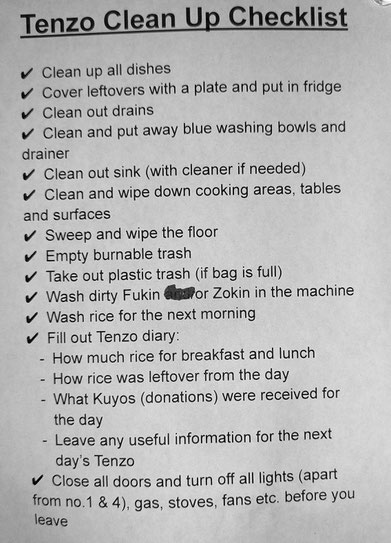
Tenzo Clean up
Here the list to remember all the detailed cleaning needed at the end of your shift as daily cook.